
How I tested my book idea before writing it
I’ve been contemplating writing a book for a while.
Ever since the turnaround of my previous company, Yools, people have suggested that I write one. In fact, others have even used Yools as a case study in their research and books.
Today, almost ten years later, I have an internal playbook that codifies my approach to building what I call “high-impact organizations”. It has been battle-tested in dozens of companies.
At some point I realized: maybe it’s time to share it with a wider audience.
But writing a book is a time-consuming project. Before writing anything, I wanted to validate a few key assumptions.
Assumption 1: Leaders can apply written guidance on their own
Question: Could leaders achieve meaningful organizational progress using written materials alone, without human guidance?
Answer: For a while now, I have been publicly sharing a “starter kit” from my CEO Playbook. Several entrepreneurs applied these free materials and achieved surprisingly strong results.
Of course, written resources cannot fully replace human guidance, which is why some of them later became clients.
Still, this gave me confidence that a well-structured, practical book could genuinely help people implement these ideas on their own.
Assumption 2: The title resonates with people
Question: Is Building High-Impact Organizations the right title, or could I find something more appealing?
To find out, I asked six friends to rate the following titles. (Some of them sound quite bad to me now. 😳)
Titles
I came up with six potential titles. Before reading on, you’d do me a big favor by voting on your favorite one. 🙏
Numbers 3, 4, and 5 came out more or less tied.
That’s why I need your help to identify a winner, so please vote for your favorite if you haven’t done so yet.
For now, I decided to stick with Building High-Impact Organizations. It’s a phrase I have already been using for a while, and it captures the core idea of the book well.
Subtitles
I also tested six subtitles with my friends:
A Tactical Guide to Unlocking Initiative, Collaboration, and Leadership in Teams
A Tactical Guide to Overcoming the Team Engagement Paradox
27 Surprising Practices to Liberate Teams and Develop Leaders
Surprising Tactics to Liberate Teams and Develop Leaders
A Platform for Self-Development That Unlocks Team Engagement and Conscious Leadership
Develop Your Team, Step Aside, and Work on What Matters
Here, numbers 1 and 6 performed best.
For now, I chose option 1 because it best reflects the book I have in mind.
Assumption 3: The book cover triggers interest
Even with a good title, a book needs to grab attention online.
Question: Could I come up with a book cover that actually makes people click?
To test this, I spent €100 on ads on LinkedIn, since that’s where my audience is.
I measured two things:
Click-through rate on the ad
Conversions on the landing page (= entering email to get the book)
The call to action was simple: “Download the book for free.”
(Ideally, I would test whether people are willing to pay for the book. But that requires a much larger ad budget because conversions are lower. At this stage, I decided that two actions would be a strong enough signal of interest: clicking the ad and requesting the book.)
Test 1: The ad image
I tested two images.
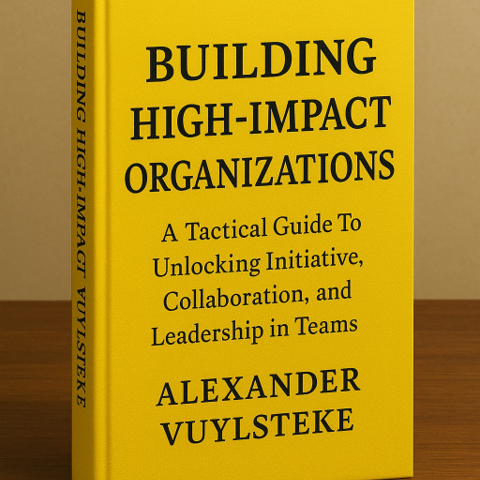
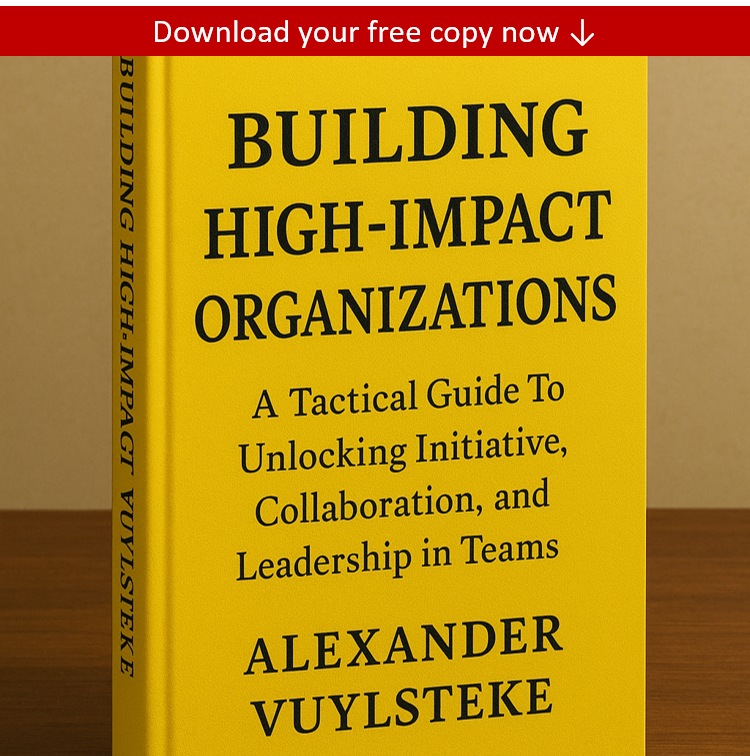
Results
Image 2, with the red bar, clearly outperformed Image 1, with a click-through rate almost twice as high:
| Image 1 | Image 2 | |
|---|---|---|
| Spent | €21 | €79 |
| Clicks | 4 | 19 |
| Click-through rate (CTR) | 0,42% | 0,79% |
| Cost per click (CPC) | €5,28 | €4,15 |
It’s a small sample, but the difference was clear enough to keep the red bar version.
Test 2: The ad description
I also tested several descriptions below the image.
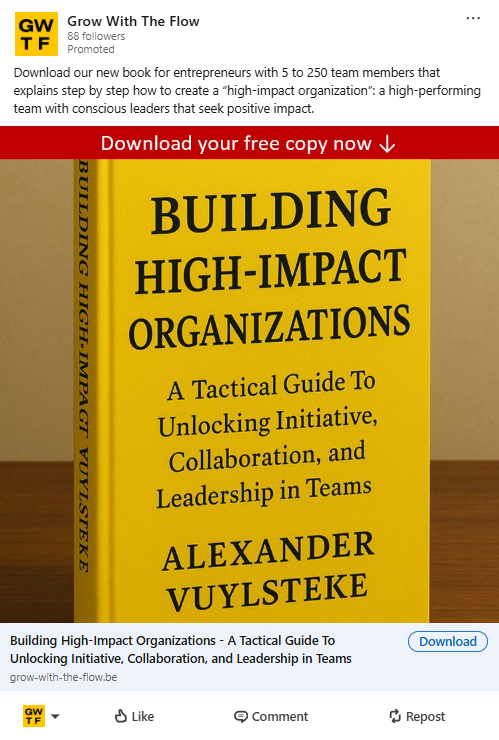
The clear winner was the following one, with a 17% higher click-through rate than the second-best option and a 30% lower cost per click:
Download our new book for entrepreneurs with 5 to 250 team members that explains step by step how to create a “high-impact organization”: a high-performing team with conscious leaders who seek positive impact.
This is what the best-performing ad looked like:
Test 3: The landing page
Finally, I tweaked the initial landing page after sensing that it was not converting as well as it could.
The main change I made was inserting a visual image just below the fold.
That alone increased the conversion rate from 1 download out of 14 visits (7%) to 3 downloads out of 9 visits (33%).
Again, the sample is tiny, but the improvement was large enough to keep the change.
Conclusion
While further validation is always possible, these results encouraged me enough to move forward with the book project.
A CTR of almost 1% on LinkedIn ads is quite solid for a topic like this.
A 33% conversion rate on the landing page is excellent, even if the sample size was small.
I am now close to finalizing a first version, which I will share with a small circle of proofreaders.
Next, I plan to validate the book draft by pre-releasing it in phases, gathering reader feedback, and improving it along the way. Only then will I invest time and resources in a more professional release.
Want to follow the progress?
To see what the landing page currently looks like, visit: www.grow-with-the-flow.be/book
💡If you subscribe there, you will receive updates as the book progresses. I plan to release the book in phases, and subscribers will get early access to new chapters and previews.
More coming soon!
Check out my new book
(free pre-launch)
My new book outlines a practical approach to building teams that excel because of — not despite — their humanity. It explains how to create a workplace that that fuels personal growth in service of the company’s mission and creates purpose-driven leaders focused on positive impact.
Click here to check out my book